

A customer enquiry lands with incomplete details. An invoice needs checking against a purchase order. A sales lead looks promising but requires research before it reaches the CRM. These are the moments when the choice between AI assistants versus automation tools becomes practical, not theoretical. The right answer can reduce pressure on your team. The wrong one can create more exceptions, more checking and another system that nobody fully owns.
For Australian businesses managing growth with lean teams, both options can be useful. They solve different problems, however. Automation tools are built to repeat defined actions. AI assistants can interpret context, produce drafts, investigate information and support judgement. Neither replaces the need for clear processes and accountable people.
AI assistants versus automation tools: the core difference
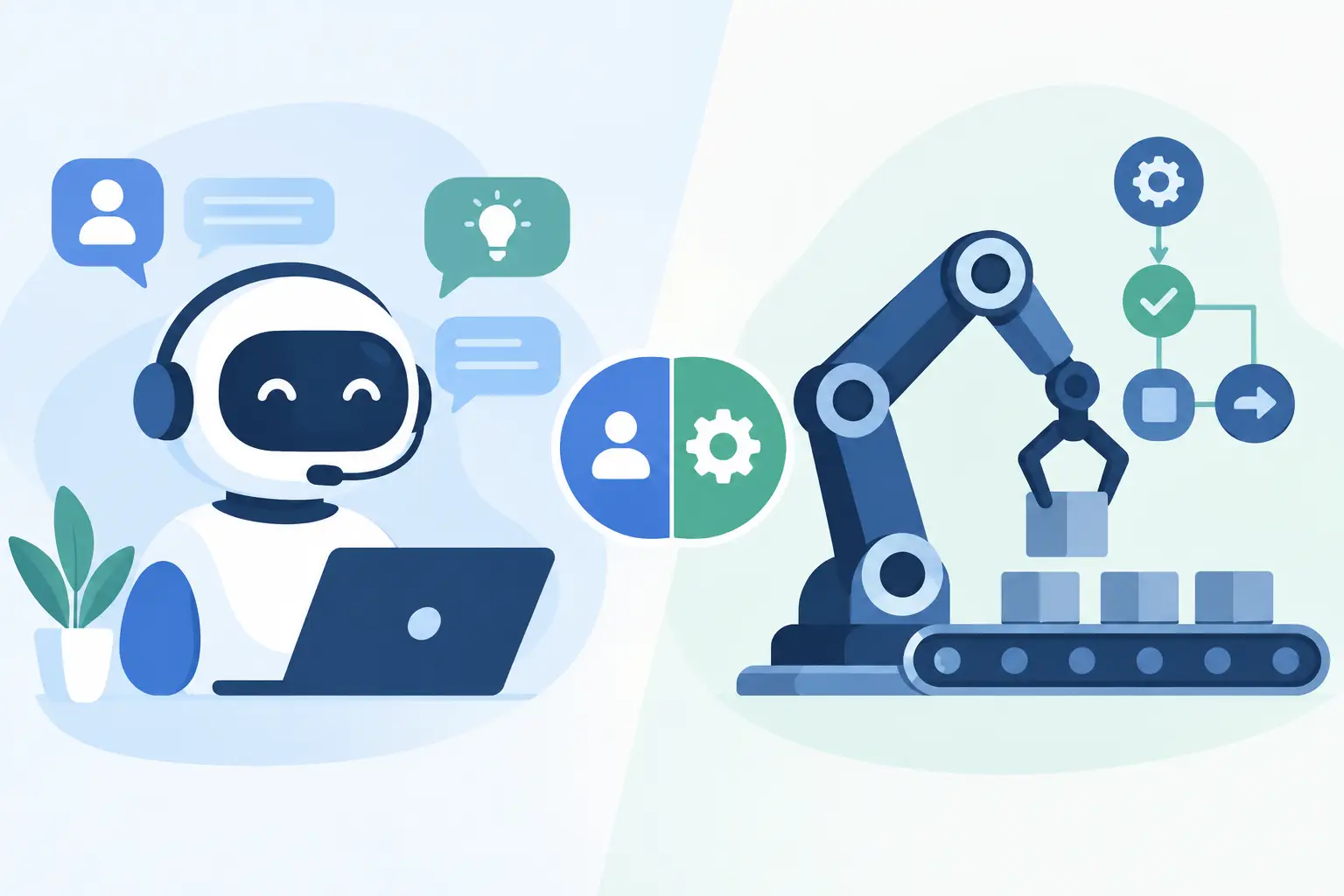
Automation tools follow rules. A trigger occurs, the system performs a pre-set action, and the result moves to the next step. For example, when a web form is submitted, an automation may create a CRM record, assign an owner, send an acknowledgement email and notify a sales channel. It works well because the inputs, sequence and outputs are predictable.
An AI assistant works with language, documents and less structured requests. It can summarise a meeting transcript, turn rough notes into a client-ready proposal, categorise a batch of enquiries or prepare a first response based on your approved knowledge base. It does not simply follow a fixed path. It makes a probabilistic judgement based on the information it receives.
That distinction matters when mistakes carry a cost. An automation can be highly dependable when the rule is correct. An AI assistant can be flexible when the work varies, but it needs instructions, guardrails and review. It may interpret an ambiguous request differently from the way your team would.
The simplest way to assess the work is to ask two questions: is the process consistent, and does it require judgement? Consistent, low-judgement work is a strong candidate for automation. Variable work that involves interpreting information is more suitable for an AI assistant, usually with human oversight.
Where automation tools earn their place
Automation is particularly valuable for high-volume, repeatable tasks that teams should not be completing by hand. It can remove the small administrative delays that build up across a week, particularly when multiple systems need to stay aligned.
A service business, for instance, may automate appointment reminders, form routing and post-service feedback requests. An eCommerce team may automate order-status notifications, low-stock alerts and product review follow-ups. A finance team may automate invoice reminders or flag records that meet a defined exception rule.
The benefit is consistency. Once an automation has been tested, it does the same thing at 9 am on Monday as it does late on Friday. It does not forget a step because it is handling a competing client request.
But automation has limits. It can move a poor process faster, which is not a genuine improvement. If your lead form captures inconsistent information, an automated workflow may create incomplete CRM records at scale. If customer enquiries regularly need context from past interactions, a basic auto-reply can feel impersonal or send the issue in the wrong direction.
Before automating, document the current process. Identify the trigger, the data required, the owner, the exception path and the desired outcome. This work often reveals that a process needs tidying before it needs technology.
When an AI assistant is the better fit
AI assistants are useful when the work requires a first pass of analysis, writing, sorting or research. They can help a team move from a blank page to a usable draft much faster, especially where employees are spending hours processing information rather than making decisions.
Consider a virtual assistant supporting an operations manager. They may use approved AI workflows to summarise meeting actions, draft standard operating procedures from recorded processes, prepare weekly customer service themes or turn a detailed brief into social media copy for review. The virtual assistant provides the operational context, checks the output and ensures it aligns with your business standards.
This combination is often stronger than asking an AI tool to operate without supervision. A dedicated team member understands which client is sensitive, how your internal naming conventions work, what needs escalation and where a response requires a personal touch. They can also identify recurring issues that should be solved with a better process rather than another prompt.
AI should not be handed confidential information without a clear policy. Businesses should decide which tools are approved, what information may be entered, where files are stored and when a manager must review output. This is especially important for financial information, customer data, employment records and commercially sensitive material.
The strongest model often combines both
The choice is rarely AI or automation. The most effective operating model assigns each part of the workflow to the capability that handles it best, with a person accountable for the result.
Take lead generation. Automation can collect form submissions, enrich standard fields and route leads to the right pipeline. An AI assistant can help draft a tailored first outreach message or summarise publicly available company information. A dedicated lead generation specialist can then verify relevance, personalise the communication, update records accurately and decide which opportunities deserve follow-up.
The same approach applies to customer service. Automation can acknowledge a request and set expectations. AI can suggest a response based on approved content. A trained customer service professional can review the context, resolve exceptions and protect the customer relationship. The customer receives a timely response without being forced through a rigid workflow when their issue is unusual.
For many growing businesses, this is where offshore staffing creates practical capacity. Instead of expecting a founder or department head to configure every tool, review every AI output and manage every recurring task, a dedicated remote professional can own the day-to-day workflow. They can maintain templates, improve documentation, monitor exceptions and escalate issues at the right time.
Virtual Coworker matches Australian businesses with dedicated, AI-skilled professionals in the Philippines who work Australian hours and are selected around the responsibilities, systems and approved workflows of the role. That matters because tools alone do not create process ownership.
A practical decision framework for your team
Start with the work, not the software. Map the recurring tasks that consume time each week and assess them against four factors:
- Volume: Is the task performed often enough for a process improvement to matter?
- Variation: Are the inputs predictable, or does each request arrive with different context?
- Risk: What happens if an action or recommendation is wrong?
- Ownership: Who checks exceptions, maintains the process and improves it over time?
A high-volume, low-variation task such as sending a confirmation email is usually ready for automation. A high-variation task such as preparing an executive briefing may benefit from AI-assisted drafting and a skilled executive assistant’s review. A task with high risk, such as approving payments or giving financial advice, should retain appropriate human control even if AI or automation supports preparation.
It also helps to distinguish between saving minutes and creating capacity. A tool that saves five minutes once may not justify implementation and maintenance. A well-designed process that gives a team member back two hours every day can change what the business can take on.
Common mistakes to avoid
The first mistake is treating AI as a replacement for process knowledge. AI produces better work when it has clear instructions, relevant examples and defined boundaries. If your team cannot explain what a good outcome looks like, the tool cannot reliably infer it.
The second is automating a workflow before someone has completed it manually enough times to understand the exceptions. Start with a documented process, then automate the stable steps. Keep a clear path for unusual cases.
The third is leaving nobody responsible after implementation. Software may run in the background, but it still needs monitoring. Someone should review failed automations, update templates, test changes and make sure customer-facing messages remain accurate.
Finally, avoid measuring success only by the number of tools in use. A smaller stack, supported by a capable person who understands the work, is often more valuable than a collection of disconnected platforms.
The productive question is not whether AI assistants or automation tools will run your business. It is which work should be standardised, which work needs judgement, and who will own the result. Start with one recurring bottleneck, assign clear responsibility and build from a process your team can trust.